
RACEM Magazine
Which wheels fit a car? Bolt pattern, ET, width, and registration for MOT
A practical guide to wheel dimensions. We will explain what ET and bolt pattern mean, how to choose the width and tire, and what to expect during MOT and registration in your vehicle's technical certificate.
Choosing wheels is one of the first things you deal with on a car, and also one of the easiest to get wrong. Just one wrong number and the wheel rubs against the fender, you feel vibration on the highway, or your car fails inspection.
The good news is that it's all about five values: bolt pattern, center bore, offset (ET), width, and diameter. Once you understand them, you'll choose wheels without guessing and without unpleasant surprises. Let's go through them in order, including what actually applies in Slovakia for MOT and registration in the technical certificate.
01How to read wheel and tire dimensions
Before you start choosing anything, it's worth knowing how to read what you already have on your car. A wheel usually has a size embossed on it that looks something like this: 8.5J x 18 ET35 5x120. The number 8.5J is the wheel width in inches, 18 is the diameter in inches, ET35 is the offset in millimeters, and 5x120 is the bolt pattern, meaning five bolts on a circle with a diameter of 120 millimeters.
A tire has its own marking, for example 225/40 R18. The number 225 is the tire width in millimeters, 40 is the aspect ratio, meaning the sidewall height as a percentage of the width, and R18 is the diameter, which must match the wheel diameter. If you can read and understand these two lines, most of the work is done, and the rest is just about making sure the numbers match each other and your car.
02Bolt pattern and center bore: numbers that must match
These are two values for which there is no compromise. They either fit, or you simply cannot mount the wheel on the car.
Bolt pattern (PCD)
The bolt pattern, or PCD, tells you how many bolts the wheel has and on what diameter circle they are spaced. It is written, for example, as 5x112, which means five bolts on a circle with a diameter of 112 millimeters, and it must be accurate to the millimeter. In practice, for example, a large proportion of VW, Audi, Škoda, and Seat vehicles use 5x112, BMW uses 5x120, although newer models have switched to 5x112, many Japanese cars including Nissan use 5x114.3, and older cars like the Honda Civic or Mazda MX5 use 4x100. You can find your bolt pattern in your technical certificate, on the original wheels, or in a catalog by make, model, and year of manufacture.
Center bore diameter (hub)
The center bore is the hole in the center of the wheel that sits on the wheel hub and carries the weight of the car. If the bore is smaller than the hub, you cannot mount the wheel. If it's larger, which is common with aftermarket wheels, the wheel is not centered, and you must use hub centric rings. Without them, you will feel vibration at higher speeds, which people often mistake for poorly balanced wheels.
03ET, or offset, and car stance
ET is the value around which most debates revolve, and rightly so, because it determines how the car looks and whether it will rub. Simply put, ET indicates how far the wheel's mounting surface is from its central axis. A lower ET moves the wheel further out towards the fender edge, which is called poke, and a higher ET tucks it deeper under the fender.
The following table illustrates the principle. Specific values vary from car to car, so use it as a guide, not as exact numbers for your model.
| Offset | Wheel position | How it manifests |
|---|---|---|
| Lower ET | Wheel further out, closer to the fender | More aggressive stance and poke, but higher risk of rubbing |
| Medium ET | Balanced position under the fender | The most versatile and safest choice for most cars |
| Higher ET | Wheel further in, deeper under the fender | More conservative look, but possible contact from the inside |
If you want to get the wheel further out, you go for a lower ET or help yourself with a thin spacer. If your wheel rubs the fender from the outside, you need the opposite direction, i.e., a higher ET, a narrower tire, more negative camber, or fender flares. Never solve it with just one number; it always works as a whole.
04Wheel width, tire, and stretch
A certain range of tire widths fits one wheel width. When you stretch a narrower tire onto a wider wheel, it creates what is called a stretch, meaning a tensioned tire with the sidewall pulled inward at an angle. It is popular in the stance and drift scene because it helps avoid rubbing against the fender and gives a distinctive look. If, on the other hand, you primarily drive on the road and want comfort and grip, opt for a fuller profile. Therefore, you always choose the wheel and tire width according to what you want from the car, whether it's everyday driving, track, or drift.
05Why the wheel rubs and how to fix it
Most problems with new wheels revolve around rubbing. When your wheel rubs after installation, the first step is to find out exactly where, because the solution from the outside and the inside is completely opposite. On lowered cars, there is less space in the fender, so adjustable suspension and correctly set geometry also play a role. Here's a quick guide to help you determine the cause.
Quick guide for rubbing
- Rubs the fender from the outside: you need a higher ET, narrower tire, more camber, or fender flares
- Rubs the shock absorber or suspension from the inside: a lower ET or a thin spacer will help
- Rubs only during greater compression: check ground clearance and suspension travel
- You feel vibration at speed: likely missing hub centric rings or the wheel is poorly centered
If you're dealing with rubbing after lowering, check out our suspension and axle parts, where you'll also find spacers and components for fine-tuning geometry.
06MOT and registration of wheels in the technical certificate
This is a part that should not be taken lightly, as it can spoil an otherwise successful build. When you change the size of your wheels compared to what is recorded in your documents, it generally applies that the new size must be approved or homologated for the vehicle, and the change is registered in the technical certificate. During the technical inspection, the technician primarily checks whether the wheel does not protrude from the fender and whether it does not rub during full suspension compression and full steering lock.
That's why it makes sense to opt for parts with certificates and technical assessments, as they will significantly facilitate approval and registration. For each part in our offer, we state whether it has a certificate, so you know in advance what to expect during inspection. Conditions change over time, so always verify the final size with a technician before installation; this will save you time and money.
07Frequently asked questions
Which wheels fit my car?
Those that have the same bolt pattern and center bore diameter as your car, plus a suitable offset (ET) and width that matches the chosen tire. The bolt pattern and hub must fit precisely, while ET and width determine the stance and whether the wheel will rub.
What does ET mean on wheels?
ET is the offset, i.e., the distance of the wheel's mounting surface from its central axis in millimeters. A lower ET moves the wheel further out, a higher ET tucks it deeper under the fender. It is the most important number for the car's stance.
How do I find out the bolt pattern for my car's wheels?
You can find the bolt pattern in your technical certificate, on the original wheels, or in a catalog by make, model, and year of manufacture. It is written, for example, as 5x112, meaning five bolts on a circle with a diameter of 112 millimeters.
Do wheels need to be registered in the technical certificate?
If you change the size compared to the documents, generally the new size must be approved for the vehicle and the change must be registered. Parts with certificates and technical assessments significantly facilitate this. Verify the exact conditions with a technician, as they change over time.
Are wheel spacers a problem for MOT?
Quality spacers with correct bolts or extended studs and proper tightening are commonly used. It is important that the wheel still fits within the fender after their installation and does not protrude, otherwise there may be a problem during inspection.
What is the difference between 5x112 and 5x120?
These are two different bolt patterns, meaning the diameter of the bolt circle is either 112 or 120 millimeters. They are not interchangeable; a wheel with a different bolt pattern will not fit the hub correctly.
Are you choosing wheels for your car?
Check out our range of wheels and suspension parts. For each part, we also list certifications, so you know in advance what will pass inspection.
View wheels
Čítajte ďalej
Ďalšie z RACEM MAGAZINE

27. 9. 2026
Golf 4 tuning: 6 úprav, ktoré sa oplatia, a čo prejde na STK
Praktický sprievodca tuningom VW Golf 4. Zníženie, nárazník R32 Look, Angel Eyes svetlá, prahy aj disky, s cenami a tipmi pre STK.
Čítať ďalej →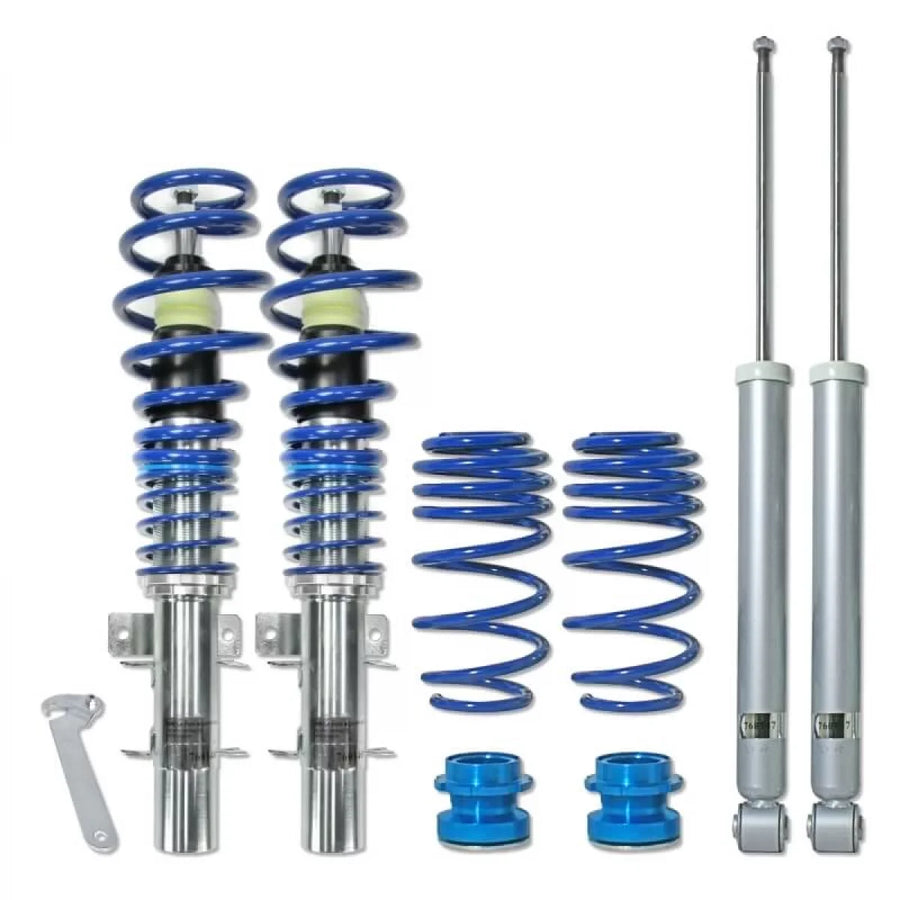
27. 9. 2026
Znižovacie pružiny, znižovacia sada alebo gwinty? Ako znížiť auto správne
RACEM Magazín Znižovacie pružiny, znižovacia sada alebo gwinty? Ako znížiť auto správne Praktický sprievodca znížením auta. Vysvetlíme rozdiel medzi pružinami, kompletnou sadou a výškovo nastaviteľným podvozkom,...
Čítať ďalej →
23. 9. 2026
Karbónové diely: pravý karbón alebo imitácia?
RACEM Magazín Karbónové diely na auto: pravý karbón, dry vs wet a hydro dip Praktický sprievodca karbónom na aute. Vysvetlíme rozdiel medzi pravým karbónom, suchým a...
Čítať ďalej →